
About the Course
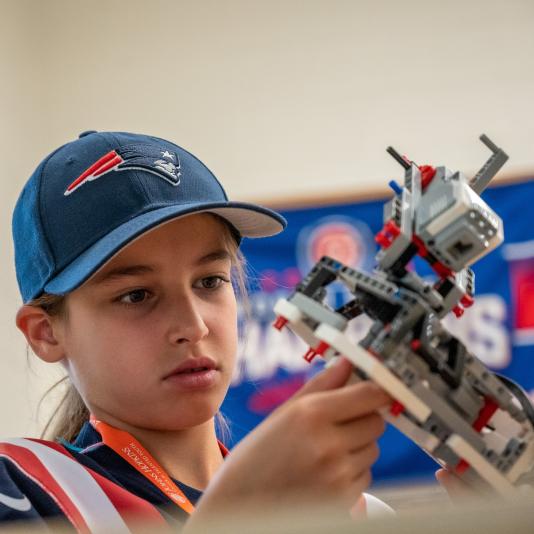
In the field of robotics, computer science and engineering interface to create interdependent systems that can perform a variety of tasks, from manufacturing microchips to exploring Mars. In this course, we'll learn computer science concepts and explore topics such as algorithms, sequential control flow, and Boolean operators. We'll survey basic principles of physics and mechanical engineering, such as simple machines and locomotion, and of electrical engineering, such as circuits and sensor feedback. You and your classmates will build, program, and test robots in a modern programming environment. With each project, learn the basic computer science and engineering principles that underlie everything from home toasters to space shuttles, and gain a foundation in fields that will become increasingly important in the highly technical 21st century.
Typical Class Size: 14-16
Learning Objectives
- Design, plan, and build interdependent autonomous machines using robotics parts
- Create and interpret flow charts, building sketches and explaining them through documentation
- Compare and contrast software, hardware, and firmware and their role in robotics
- Formulate the main principles of programming including algorithm, variable, conditional, iteration, parallel/serial processing and subroutines, and test systems using an object-oriented or non-graphic user interface platform
- Construct and demonstrate inputs, outputs, and processing within a program, system, and robotic device
- Develop and explain ideas of feedback and control structures within a network, and a centralized and decentralized system
- Present algorithmic solutions as executed by a robot, and explain their processes
- Justify the use of structure, center of gravity, torque, traction, and other physical attributes in effective robot design
- Defend the importance of voltage, current, transistors, and other electrical aspects of robot design
- Propose general practices and structures of software programming languages
About Advanced Enrichment courses
These courses offer above-grade-level material that is presented in a novel context, explored with other advanced learners, and guided by a CTY educator to help prepare students for higher-order thinking and college-style academic challenges. Students work individually and may finish the course early if they complete all requirements before the course end date.
Requirements
CTY courses have grade-level requirements and most require minimum test scores. Some courses may also have prerequisites.
Identification DetailsDates and Tuition
It looks like there are no upcoming sections right now. Stay tuned for new dates!
Registration Fee and Financial Aid
Tuition and fees will be waived or reduced for students who qualify for financial aid.
Learn more about Financial Aid