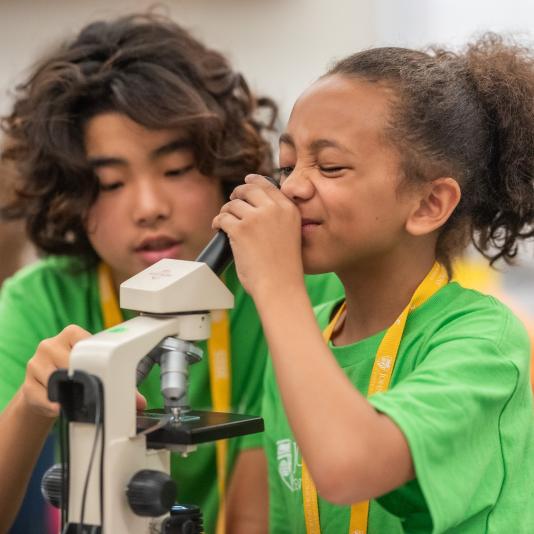

About the Course
This course covers material ordinarily included in a year-long introductory course in high school biology, typically a prerequisite for AP® or IB Biology. We'll begin with the smallest unit, the atom, and build toward discussions of ecology and the environment. Along the way, we'll sample biochemistry, genetics, and cellular processes, and integrate these concepts into our studies of evolution and systems of living things, such as respiration and reproduction. Through readings, lectures, and lab work, you'll finish the course with a strong foundation in biological concepts. Lab time constitutes at least 20 hours of the course. This course is intended for students who have completed grade 8 or above. If you have just completed grade 7, you are urged to take CTY's Introduction to the Biomedical Sciences before taking this course.
Typical Class Size: 18-20
Learning Objectives
- Demonstrate the significance of evolution in biology to include that evolution is a series of changes, some gradual and some sporadic, that account for the present form and function of objects, organisms, and natural systems. The general idea of evolution is that the present arises from materials and forms of the past and demonstrates changes in the universe
- Justify, using examples of biological processes, that matter and energy in a system is neither created nor destroyed, but cycles through changes as systems transform energy from one form to another and transfers from one location, across the boundary of a system, to another location
- Evaluate the impact of disruptions to populations and ecosystems through observable and measurable changes to demonstrate that interactions of organisms can influence each other to cause some effect that usually involves multiple interactions and impact
- Combine the concepts of meiosis, mitosis, genetics, central dogma of molecular biology, natural selection, and evolution into one coherent explanation for biodiversity
- Defend the concept that homeostasis is achieved through everyday events and processes involving multiple interactions occurring simultaneously and/or chains of interactions over time
- Prove in biological terms that form and function are complementary aspects of organisms and systems in the natural world, apply to different levels of organization, and one can be explained in terms of the other. (Function can be explained in terms of form and form can be explained in terms of function.)
- Produce three written scientific lab reports that include creating visual representations of biology concepts, processes and models as well as analysis and interpretation of data to justify a well-supported conclusion
About Extreme Acceleration courses
These courses offer topics condensed into a highly concentrated and accelerated learning experience, and are best suited for advanced learners craving a truly intensive challenge. In online Extreme Acceleration courses, students progress at their own pace with guidance from instructors.
Requirements
CTY courses have grade-level requirements and most require minimum test scores. Some courses may also have prerequisites.
Identification DetailsDates and Tuition
It looks like there are no upcoming sections right now. Stay tuned for new dates!
Registration Fee and Financial Aid
Tuition and fees will be waived or reduced for students who qualify for financial aid.
Learn more about Financial Aid