
About the Course
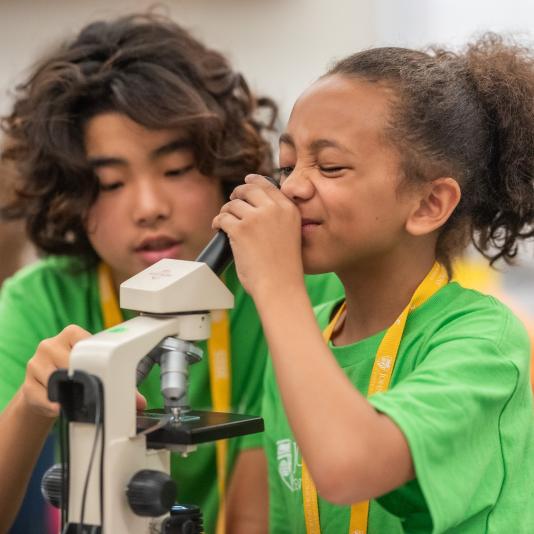
Today's 3D microscopes that can capture the nerve connections in a brain are a far cry from the magnifying lenses ground by hand in the 13th century. Yet both share a place in scientists' fascination with the microscopic world. In this course, you'll examine and compare living unicellular and multi-cellular organisms such as algae, elodea, rotifers, and paramecia, and learn to differentiate between bacterial, animal, and plant cells. You and your classmates will get comfortable doing laboratory tasks like staining, preparing wet mounts, extracting DNA, inoculation, building models, and writing lab reports while examining atoms and larger molecules, and exploring the various ways microscopes are used in fields like pathology, microbiology, and forensic science. You'll learn to think and do research like a real scientist and gain an introduction to high school biology along the way.
Typical Class Size: 12
Learning Objectives
- Examine the parts and functionality of microscopes including comparing different types of microscopes, identifying and labeling parts of a microscope, calculating magnification, explaining how light, refraction, and magnification make a microscope work, demonstrating and considering best practices for operating a microscope
- Operate microscopes to make observations and record specific details in a lab notebook, such as the color, shape, and features of different cells and multicellular organisms
- Examine real-world scientific applications of different microscopes used in plant science, animal science, microbiology, genetics, and forensic science
- Model the use of microscopes to investigate and research parts of cells, DNA extraction, fingerprint analysis, and other collected objects and organisms
- Evaluate evidence and draw conclusions from qualitative and quantitative data gathered from microscopic research
About Advanced Enrichment courses
These courses offer above-grade-level material that is presented in a novel context, explored with other advanced learners, and guided by a CTY educator to help prepare students for higher-order thinking and college-style academic challenges. Students work individually and may finish the course early if they complete all requirements before the course end date.
Requirements
CTY courses have grade-level requirements and most require minimum test scores. Some courses may also have prerequisites.
Identification DetailsDates and Tuition
In Person

Gilman School
Baltimore, MD Day Site
You will be asked to join or sign in first.

Register by: July 12, 2026
Full Waitlist Available
Time Commitment:
This course has a lab fee of $187.
Course Materials
Students should bring basic school supplies like pens, notebooks, and folders to their summer program. You will be notified of any additional items needed before the course begins. All other materials will be provided by CTY.
Sample Reading
These titles have been featured in past sessions of the course, and may be included this summer. CTY provides students with all texts; no purchase is required.
The Usborne Complete Book of the Microscope, by Kirsteen Rogers
Registration Fee and Financial Aid
Tuition and fees will be waived or reduced for students who qualify for financial aid.
Learn more about Financial Aid