About the Course
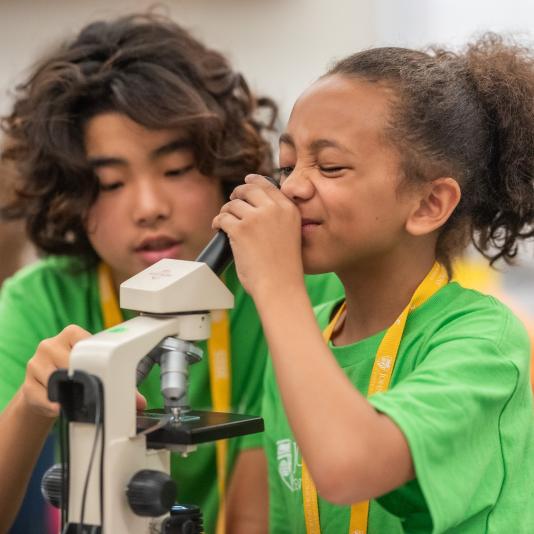
How do we see, perceive, and describe the world around us? We can use mathematics to measure, calculate, and find patterns. We can use technology to expand what we see and observe. And we can tell stories to capture details and create meaning from our experiences. This course sampler gives students an opportunity to explore and describe the world from new and different perspectives. The sampler will be designed with three cohorts of 3rd and 4th grade students using the following courses as a basis: Math: Geometry and Spatial Sense Spatial understanding is necessary for interpreting, understanding, and appreciating our inherently geometric world. Many everyday tasks such as designing a treehouse, solving a jigsaw puzzle, or laying out a garden require spatial reasoning abilities. This course will help students develop those abilities through hands-on investigations and discussions about big ideas as they learn practical and fun ways to apply geometric foundations and spatial sense to the larger world. In this course, students will learn how to: Use coordinates (scale drawing) to develop enlarged images Classify and categorize angles and geometric shapes Define and calculate perimeter, area, and volume Compare geometric objects to determine best fit Construct figures using a protractor, compass, and straight edge Science: Through the Microscope Today's 3D microscopes that can capture the nerve connections inside a brain are a far cry from the magnifying lenses ground by hand in the 13th century. Yet both can help us think critically about microscopic worlds. In this course, we'll learn to identify the parts of a microscope and how they work together to serve as a window into another world. We'll learn how scientists use microscopes and we'll record our own observations ,such as the color, shape, and features of different cells and multicellular organisms,in a lab notebook. Along the way, students will learn to think and do research like real scientists and gain an introduction to the field of biology. In this course, students will learn how to: Explain how light, refraction, and magnification make a microscope work Examine and identify the parts and functionality of a microscope, and calculate magnification Use microscopes to make observations and record specific details in a lab notebook, such as the color, shape, and features of different cells and multicellular organisms Model scientific techniques for using microscopes as a tool to investigate cell responses to changes in the cell's environment Writing: Being a Reader, Becoming a Writer How do writers effectively capture the people and places they observe? In this course, we'll read pieces of fiction and nonfiction and begin to explore the elements of good storytelling. Students will learn to provide details that develop character and a sense of place, and to think inwardly as they write a short story or personal narrative based on people and places they know. In this course, students will learn how to: Keep a writer's journal Create a story using the writing process Explain the basic elements of narrative writing Understand and apply the concept show, don't tell Illustrate and apply elements of character development Apply various writing techniques for creating a setting of a story Explain the importance of the use of the five senses and realistic details in a story Provide constructive feedback to peers in a writers' workshop setting
About Sampler courses
Samplers provide the opportunity to explore a common theme across multiple disciplines during the time window typically allotted for one course.
Requirements
CTY courses have grade-level requirements and most require minimum test scores. Some courses may also have prerequisites.
Identification DetailsDates and Tuition
It looks like there are no upcoming sections right now. Stay tuned for new dates!
Registration Fee and Financial Aid
Tuition and fees will be waived or reduced for students who qualify for financial aid.
Learn more about Financial Aid